Almost everything written about Yakkamon so far — ours included — has been about pre-registration: points, ranks, the airdrop, the mint. Meanwhile a steady drip of official screenshots and dev messages has been filling in something more interesting, which is what you'll actually be doing once the doors open.
Pulled together, it's a good deal more mechanical than the marketing copy suggests. Our Gameplay section has been rebuilt around it, going from seven systems to fourteen, and there's a new full field guide that reads the whole thing top to bottom.
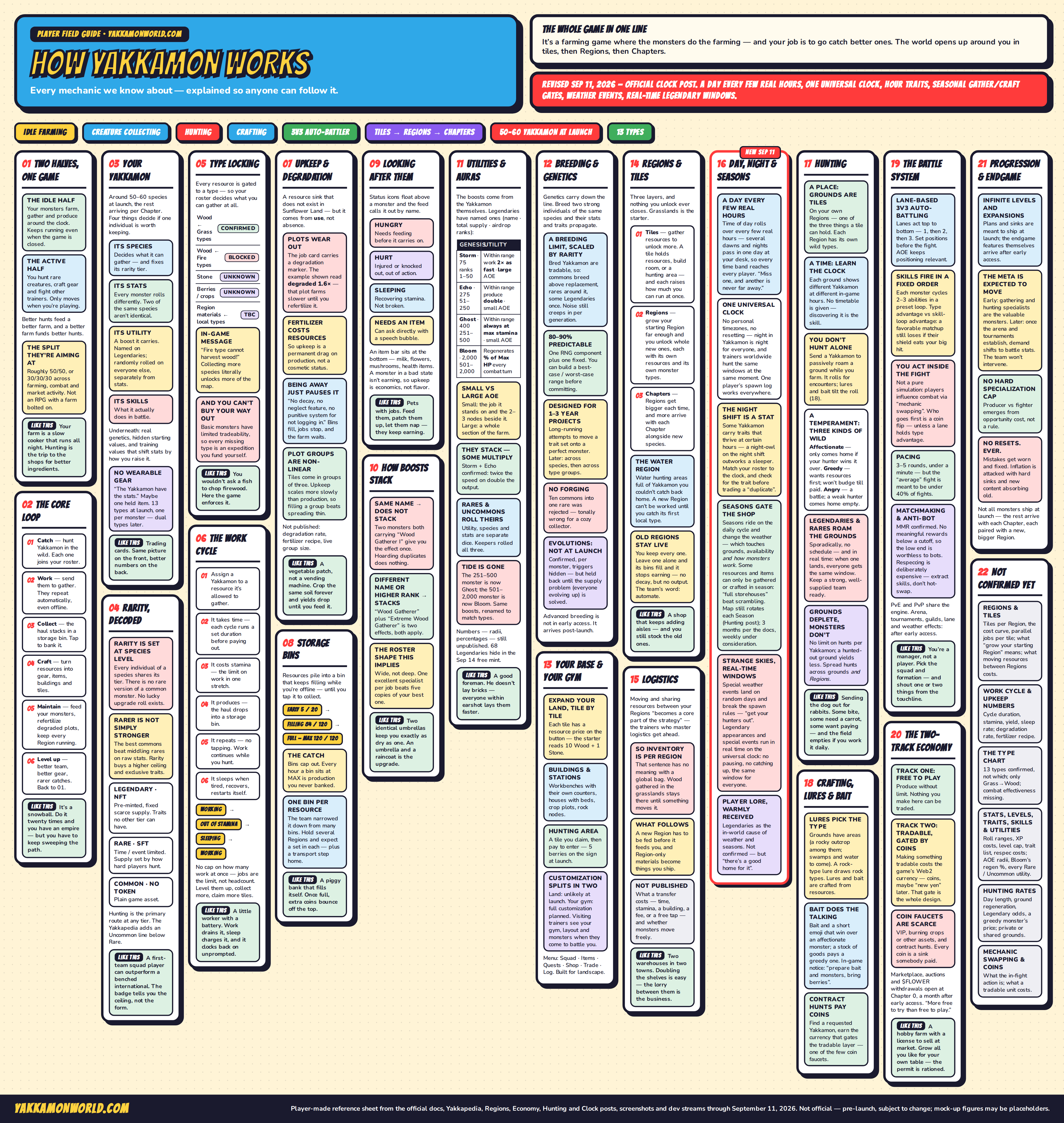
Four mechanics that change how you'd play
1. Type locking. This is the big one. Every resource is gated to a monster type: a Grass type gathers Wood, and a Fire type simply can't — the game refuses, with an in-game message reading “Fire type cannot harvest wood!”. The consequence is that your roster caps what you're able to produce at all. Collecting more species isn't a completionist's hobby, it's how you unlock more of the map's materials. Only Grass→Wood has been shown so far; Stone, berries and crops haven't been mapped.
2. Monsters run on stamina, and put themselves to bed. Gathering isn't a passive trickle. You assign a Yakkamon to a resource, the work cycle runs for a set time, it burns stamina, it drops a haul, and it repeats automatically. When stamina runs out the monster sleeps, recovers, and starts again by itself. So “idle” here means genuinely unattended — but it also means output is bounded by stamina rather than by how long you leave the game open.
3. Storage bins fill offline, then stop. Gathered resources don't go to your bag. They stack in a bin that keeps filling while you're away, capped at 20 early and 120 later, showing “MAX” when it's full. Every hour a bin sits at MAX is production you never banked. That quietly makes check-in frequency a real variable — the difference between a farm that runs all night and one that stops at 2am and waits for you.
4. Your monsters have needs. They get hungry, hurt, tired, or ask for a specific item — with status icons above them and a notification feed calling them out by name. There's an item bar of milk, flowers, mushrooms and health items for exactly this. Since a monster in a bad state stops producing, upkeep is part of the economy, not flavor.
Plus the detail from the dev streams
- Around 50–60 species at launch, with real genetics and base stats underneath. Individual stat rolls vary within a species, so hunting the same creature again for a better roll is a legitimate strategy.
- Traits are randomly rolled and define your build. Rare monsters can carry traits that change how they farm, opening approaches ordinary monsters can't run. The team put roll predictability at roughly 80–90%.
- Breeding exists, with line degradation but no hard cap, and evolutions are planned.
- Day and night run on a sped-up in-game clock, not real time. Worth knowing before anyone plans a schedule around it: no timezone gets a better night shift.
- Weather is a separate system from the day/night cycle, with its own indicators in the HUD.
- PvP is not in early access. Early access ships gathering, monsters, hunting and basic combat; PvP and advanced breeding come afterward in chapter releases.
What we've deliberately not done
A lot of the numbers circulating come from UI mock-ups rather than tuned builds. The 999,999 currency figures and the level 99 cap are almost certainly filler. We've kept those out of the guide's conclusions and labeled every figure in the quick-reference table with where it came from, so you can weigh a dev statement differently from a screenshot.
We've also kept an honest list of what isn't confirmed. Stat ranges, rarity tiers, work-cycle durations, the full type chart, the leveling curve, the trait list and the battle rules are all unpublished. That list is the reason nobody can build a trustworthy farming calculator or roster planner yet — and it's worth being suspicious of anyone claiming otherwise.